

Scientists Successfully Transfer Longevity Gene, Paving the Way for Extending Human Lifespan

Scientists have long studied unusually long-lived animals for clues to aging, but applying those insights has been difficult. Now, researchers report that inserting a single naked mole rat gene into mice extended lifespan and improved health.
Researchers at the University of Rochester have taken a bold step in “exporting” longevity biology from one mammal to another. By moving a longevity gene from naked mole rats to mice, they improved the animals’ overall health and modestly extended lifespan, an experimental result that hints at how nature’s most resilient species may reveal new levers for healthier aging.
“Our study provides a proof of principle that unique longevity mechanisms that evolved in long-lived mammalian species can be exported to improve the lifespans of other mammals,” says Vera Gorbunova, the Doris Johns Cherry Professor of biology and medicine at Rochester.
In the team’s 2023 Nature study, the key genetic change boosted production of an unusually large form of hyaluronan, high molecular weight (or high molecular mass) hyaluronic acid (HMW-HA/HMM-HA). Mice carrying the naked mole rat version of the gene had an approximately 4.4 percent increase in median lifespan, alongside multiple markers of healthier aging.
Why This Molecule Is Different in Naked Mole Rats
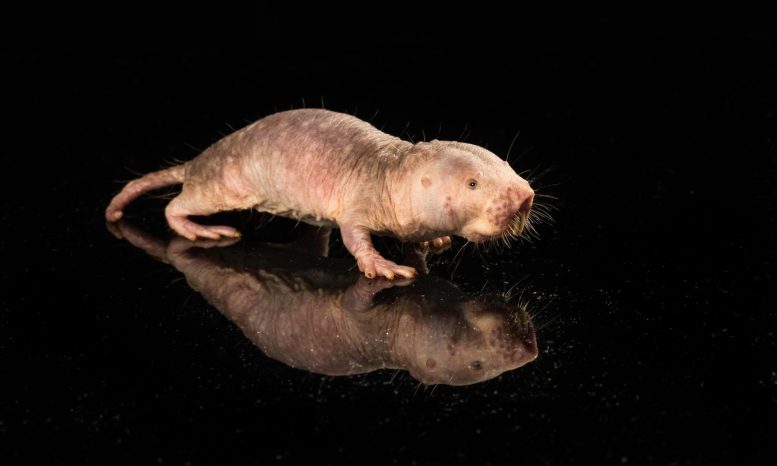
Naked mole rats have become a centerpiece of aging research because they combine an exceptional lifespan with an unusual resistance to many age-linked diseases, including cancer. Over years of work, Gorbunova and Andrei Seluanov have traced part of that resilience to hyaluronan, a gel-like component of the extracellular matrix that helps shape how cells communicate, repair damage, and respond to stress.
Hyaluronan is not inherently “good” or “bad.” Its effects depend heavily on its molecular weight. High-molecular-weight forms are often associated with anti-inflammatory, tissue-protective behavior, while smaller fragments—produced when hyaluronan is chopped up—can behave like danger signals that amplify inflammation and, in some contexts, support processes involved in tumor progression.
A future therapy can’t simply aim to “increase hyaluronan.” It would need to preserve the high-molecular-weight form and avoid shifting the balance toward smaller, potentially pro-inflammatory fragments.
Engineering Mice to Make the Naked Mole Rat Version
To test whether this mechanism could be “exported,” the team introduced the naked mole rat version of hyaluronan synthase 2 (HAS2) into mice. All mammals have HAS2, but the naked mole rat version appears tuned toward producing unusually large, abundant hyaluronan.
The engineered mice were better protected against both spontaneous tumors and chemically induced skin cancer. They also showed signs of improved health with age, particularly reduced inflammation across tissues, a notable result because persistent low-grade inflammation (“inflammaging”) is widely considered one of the central drivers of age-related decline.
The Nature work also linked high-molecular-weight hyaluronan to age-related gut integrity. As animals age, the gut barrier can become leakier, allowing inflammatory triggers to seep into circulation; the engineered mice showed protection against this deterioration, consistent with the idea that HMM-HA helps maintain tissue homeostasis rather than targeting a single organ in isolation.
The Bigger Evolutionary Clue Beneath the Surface
This may not be a one-species fluke. Follow-up comparative work has reported abundant high-molecular-mass hyaluronan across multiple subterranean mammals, often absent in closely related aboveground species.
That pattern suggests HMM-HA may be part of a broader evolutionary toolkit for surviving long lives under harsh conditions, potentially shaped by changes in both hyaluronan synthesis genes (like HAS2) and degradation pathways (including HYAL family genes).
From Gene Transfer to Drug-Like Strategies
Even the researchers emphasize that gene transfer is not the end goal. “It took us 10 years from the discovery of HMW-HA in the naked mole rat to showing that HMW-HA improves health in mice,” Gorbunova says. “Our next goal is to transfer this benefit to humans.”
The group has laid out two practical routes: increase the synthesis of HMM-HA or slow its breakdown. “We already have identified molecules that slow down hyaluronan degradation and are testing them in pre-clinical trials,” Seluanov says.
A concrete example of that “slow the breakdown” strategy appeared in a 2024 Scientific Reports study co-authored by Seluanov and Gorbunova. Using a high-throughput screen for hyaluronidase inhibitors (enzymes that degrade hyaluronan), the researchers identified delphinidin, an anthocyanidin pigment found in various fruits and vegetables, as a promising candidate.
In the study, delphinidin-mediated hyaluronidase inhibition increased high-molecular-weight hyaluronic acid in cells and mouse tissues, reduced migration/invasion in multiple cancer cell lines, and suppressed melanoma metastasis in mice.
This is especially relevant because naked mole rats appear unusual not only for how much hyaluronan they make, but also for how slowly they break it down—meaning their biology may be winning on both sides of the equation.
What This Suggests—and What It Doesn’t
Boosting HMM-HA seems to tilt aging toward a healthier trajectory—less cancer, less chronic inflammation, more resilient tissues—yet it is unlikely to be a universal shield. A July 2025 bioRxiv preprint added an important nuance: mice expressing nmrHas2 showed improvements in several late-life health measures but did not show protection from age-related hearing loss under the conditions tested, hinting that some organs may be less reachable by this pathway than others.
The Rochester work supports an increasingly testable idea: some longevity adaptations may be portable, but turning them into human therapies will likely depend on precision control, maintaining the right molecular form of hyaluronan, targeting the right balance of synthesis versus degradation, and watching carefully for tradeoffs as different tissues respond in different ways.
References:
“Increased hyaluronan by naked mole-rat Has2 improves healthspan in mice” by Zhihui Zhang, Xiao Tian, J. Yuyang Lu, Kathryn Boit, Julia Ablaeva, Frances Tolibzoda Zakusilo, Stephan Emmrich, Denis Firsanov, Elena Rydkina, Seyed Ali Biashad, Quan Lu, Alexander Tyshkovskiy, Vadim N. Gladyshev, Steve Horvath, Andrei Seluanov and Vera Gorbunova, 23 August 2023, Nature.
DOI: 10.1038/s41586-023-06463-0
“Hyaluronidase inhibitor delphinidin inhibits cancer metastasis” by Jeremy McGuire, Taketo Taguchi, Gregory Tombline, Victoria Paige, Michelle Janelsins, Nikesha Gilmore, Andrei Seluanov and Vera Gorbunova, 28 June 2024, Scientific Reports.
DOI: 10.1038/s41598-024-64924-6
“Expression of the naked mole-rat transgene for Has2 improved health span in C57Bl/6 mice, but it did not attenuate age-related hearing loss” by Connor E. Owens, Aiden J. Borruso, Kevin A. Place, Andrei Seluanov, Vera Gorbunova, Patricia M. White and Ned J. Place, 31 July 2025, bioXriv.
DOI: 10.1101/2025.07.27.667071
Never miss a breakthrough: Join the SciTechDaily newsletter.
Follow us on Google and Google News.
Source link
